

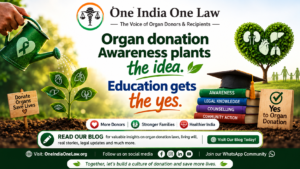
From Awareness to Action:
Why India Must Move Beyond Organ Donation Awareness Towards Organ Donation Education
Every year, thousands of Indians die waiting for an organ that never arrives. India needs close to two lakh kidneys annually, yet transplants happen for only a small fraction of that number. The gap between what is needed and what is available is not primarily a gap of infrastructure or medical skill — India has world-class transplant surgeons and hospitals. The real gap lies somewhere quieter: in the ICU corridor, at 2 a.m., when a grieving family is asked whether they will consent to donating their loved one’s organs.
For decades, India’s response to the organ shortage has been to run awareness campaigns — pledge drives on World Organ Donation Day, posters outside hospitals, celebrity messaging, and college pledge camps. These campaigns matter. But if awareness alone were enough, India’s cadaver donation rate would not still be languishing at under 1 donor per million population, while countries like Spain report rates above 40. It is time to have an honest conversation: awareness has done its job, and its returns are diminishing. What India needs now is a decisive shift towards organ donation education.
Awareness Told India That Donation Exists. It Didn’t Tell India How to Say Yes.
Awareness campaigns are built to answer one question: does the average citizen know that organ donation is possible? By that narrow measure, India has largely succeeded. Surveys consistently show that a majority of urban Indians have heard of organ donation and hold broadly positive attitudes towards it in the abstract.
But knowing that something exists is very different from knowing what to do when it actually matters. Awareness campaigns rarely explain:
- What brain death actually is, and why a ventilated, warm, breathing patient can still be legally and medically dead
- What the law — the Transplantation of Human Organs and Tissues Act, 1994, and its subsequent amendments — actually permits and protects
- What religious traditions in India genuinely say about organ donation (most major faiths practiced in India support it, yet families frequently assume the opposite)
- What the retrieval process involves, and that it does not disfigure the body or delay funeral rites
This is precisely why India’s real bottleneck is not general awareness — it is the family consent conversation that happens in the ICU when a patient is declared brain-dead. Even when a patient is medically eligible to donate, consent rates in Indian hospitals remain low, largely because families are asked to make an irreversible decision in a moment of shock, without adequate prior understanding, often by staff who are not trained to have that conversation with sensitivity and clarity.
Why Education Closes the Gap That Awareness Cannot
Organ donation education is a fundamentally different intervention. Where awareness broadcasts a message to the public at large, education builds structured, sustained understanding among the specific people whose decisions actually determine whether a donation happens.
This means:
Training ICU physicians and nursing staff to recognise brain death early, document it correctly, and communicate it to families with clarity and compassion — rather than treating it as a footnote before moving on to organ retrieval logistics.
Training transplant coordinators— a role that has proven decisive wherever it has been implemented well — to sit with grieving families, address religious and cultural doubts directly, and walk them through the process without pressure or ambiguity.
Embedding organ donation in medical and nursing curricula, so that every doctor who might one day stand in an ICU has already learned how brain death works and how to request consent, long before they are thrown into the situation for the first time.
Correcting misinformation directly, rather than leaving a vacuum for myths — about mutilation, about religious prohibition, about hospitals “harvesting” organs for profit — to fill on their own.
The evidence bears this out. States and hospital systems that have invested in transplant coordinator programmes and structured ICU training — Tamil Nadu and Telangana are frequently cited examples — have achieved meaningfully higher and more consistent donation rates than regions relying primarily on public awareness messaging. The difference was not that people in these states were more “aware.” It was that the systems around the moment of decision were better educated, better trained, and better prepared.
Awareness and Education Are Not Rivals — But India Has Over-Invested in One
None of this is an argument against awareness campaigns. They remain necessary. A society that has never heard of organ donation cannot be expected to consent to it. Awareness lays the groundwork — it normalises the idea, removes some of the taboo, and plants the first seed.
But awareness was never designed to do the heavier lifting that education does. It cannot train a resident doctor to diagnose brain death confidently. It cannot teach a nurse how to approach a family without adding to their trauma. It cannot correct a decades-old myth in a single poster. India has spent years pouring resources into the first lever while the second — the one with the stronger evidence base — remains under-resourced and inconsistently implemented across states.
What a Shift Towards Education Would Look Like
For India to meaningfully raise its cadaver donation numbers, the policy and public health conversation needs to move from “how many people have we made aware” to “how many families said yes, and why did the rest say no.” That requires:
- Mandatory, standardised training for ICU and transplant staff across all NOTTO-affiliated hospitals, not just leading centres
- A dedicated, trained transplant coordinator in every hospital authorised for organ retrieval — not as an optional post, but as a legal and operational requirement
- Curriculum reform in medical and nursing education to include brain-death communication and consent-seeking as a core competency, not an elective topic
- Community-level education, not just awareness — engaging religious leaders, local health workers, and community influencers to correct specific misconceptions rather than deliver generic messaging
- Transparent public reporting of hospital-wise conversion rates (potential donors identified vs. actual donations completed), so that gaps in training and process become visible and fixable
The Bottom Line
Organ donation awareness got India to a point where most citizens no longer consider the idea foreign or forbidden. That was necessary work, and it should continue. But awareness was always the opening chapter, not the whole story. The next chapter — the one that will actually save the thousands of lives currently lost on transplant waiting lists — has to be written in ICUs, medical colleges, and training rooms, not just on pledge cards and posters.
India does not need more people who have merely heard of organ donation. It needs more families who, in their hardest hour, understand enough to say yes — and more doctors and coordinators equipped to help them get there. That is the difference between awareness and education. And that is the shift India can no longer afford to delay.
This article is written by Advocate Prashant Ajmera – co-founder OneIndiaOneLaw.org