

When the Committee Delays, Who Pays the Price?
The Legal Accountability of India’s Organ Transplant Authorisation Committees
In India, thousands of patients wait for organ transplants. Many of them have a willing donor. Many have a hospital ready. The only thing standing between them and a life-saving surgery is a committee meeting that never seems to happen.
The Authorisation Committee (AC) and the Competent Authority (CA) — statutory bodies under the Transplantation of Human Organs and Tissues Act, 1994 (THOTA) — are the gatekeepers of living organ donation in India. Their job is to verify that a proposed donation is genuine, voluntary, and free from commercial motive. It is an important job.
But it comes with a deadline — and for too long, that deadline did not exist.
That changed on January 4, 2024.
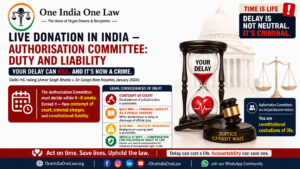
The Delhi High Court, in Amar Singh Bhatia v. Sir Ganga Ram Hospital, did something quietly historic: it fixed a binding timeline for AC proceedings. The entire process — from application to decision — must not exceed six to eight weeks. Not six months. Not “under consideration.” Six to eight weeks.
This is not a guideline. It is a direction of a constitutional court, enforceable through contempt jurisdiction. Every AC member in India is now operating under a judicially mandated standard of conduct.
What happens when that standard is breached?
The legal consequences are real and personal. An AC member who allows proceedings to drag beyond the court’s deadline — without documented justification — now faces:
- Contempt of Court — up to six months’ imprisonment
- Section 202, Bharatiya Nyaya Sanhita 2023 — criminal liability as a public servant disobeying a direction of law
- Section 106, BNS 2023 — death by negligence, if a patient dies during the period of unlawful delay
- A constitutional compensation writ — the patient’s family can sue the State under Article 21 for violation of the right to life
These are not theoretical possibilities. They are grounded in statute, in the Bhatia judgment, and in a growing line of High Court decisions that are increasingly unwilling to treat institutional delay in life-and-death matters as an administrative inconvenience.
The law has always imposed duties on these committees. Rules 7 and 18 of the THOTA Rules, 2014 set out detailed evaluative obligations — nine mandatory criteria for unrelated cases, a sequential documentary verification process for near-relative cases, an express provision for expedited processing in critical cases. What was missing was a temporal framework. The Delhi High Court has now supplied it.
What we believe:
Organ donation is an act of extraordinary generosity. Every day that a committee delays its decision is a day that generosity is held hostage to paperwork. The families who approach these committees are not petitioners seeking a favour. They are citizens exercising a statutory right to a timely decision on a matter of life and death.
The law now says: decide within six to eight weeks, decide with reasons, and decide genuinely — or face the legal consequences.
We have published a full legal analysis of this issue — examining the duty framework under THOTA Rules, the force of the Bhatia judgment, every head of criminal and constitutional liability, and the legislative reforms still needed.
Read the full Legal Analysis here → Complete Legal Analysis
Published by OneIndiaOneLaw — Legal Policy & Organ Transplant Rights Initiative This blog is for informational purposes only and does not constitute legal advice.